
Author Archives: The Historical Homemaker
Mary Todd Lincoln’s Cake
Leave a reply
We made Mary Todd Lincoln’s cake today at the bakery. It’s a very simple recipe to make (compared to something like Martha Washigton’s Great Cake!) and our customers really enjoy it. It’s so neat to be able to “taste history” and especially taste something that Abraham Lincoln enjoyed eating.
Here is the recipe:
Mary Todd Lincoln’s White Cake
(Recipe from Lincoln’s Table by Donna D. McCreary was adapted by Janice Cooke Newman)
1 cup blanched almonds, chopped in a food processor until they resemble a coarse flour
1 cup butter
2 cups sugar
3 cups flour
3 teaspoons baking powder
1 cup milk
6 egg whites
1 teaspoon vanilla extract
confectionary sugar
Preheat oven to 350 degrees. Grease and flour a Bundt cake pan.
Cream butter and sugar. Sift flour and baking powder 3 times. Add to creamed butter and sugar, alternating with milk. Stir in almonds and beat well.
Beat egg whites until stiff and fold into the batter. Stir in vanilla extract.
Pour into prepared pan and bake for 1 hour, or until a toothpick inserted comes out clean. Turn out on a wire rack and cool. When cool, sift confectionary sugar over top
A basic white frosting sprinkled with almonds was also popular.
Recipe and more information can be found here
Today in American History…
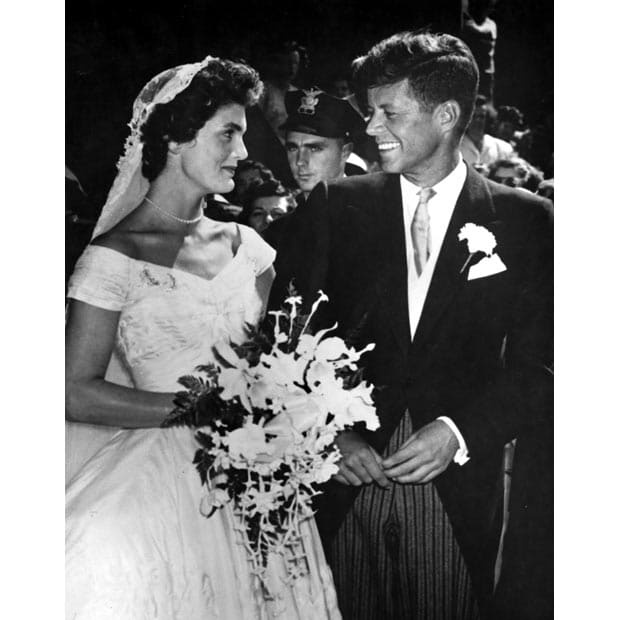
Today in American history…John F. Kennedy marries Jacqueline Bouvier on September 12, 1953 in Newport, RI #JFK #JBK #POTUS #FLOTUS #TodayInHistory
We are at Colonial Williamsburg 🇺🇸
Having a wonderful time visiting Colonial Williamsburg. What a great way to celebrate our Nations independence 🇺🇸

Visit to Hupp’s Hill
There is a famous saying that goes something like “ya never know what you might find in your own backyard…”
Jim and I decided to spend a beautiful Sunday afternoon over at Hupp’s Hill Civil War Park. We drive past the large signs daily to and from work every single day and have often commented that we needed to stop by and visit and see what exactly was “Hupps Hill.” We have all heard about the battles of Gettysburg…Bull Run…Antietam…and Cedar Creek which is not too far from us in the Shenandoah Valley.

What is Hupp’s Hill?
After our visit yesterday? I can only say it is a treasured place that is one to be sought out by all.
When we first entered the museum and gift shop we were so graciously welcomed by Linda who is a Tour Guide and Historian at Hupp’s Hill. Linda walked us through the museum and told us the fascinating true story of the events leading up to the fighting at Hupp’s Hill that led up to The Battle of Cedar Creek. There were some things that I learned for the very first time for example…President William McKinley and President Rutherford B. Hayes fought at The Battle of Cedar Creek before they were elected to office.


It was interesting to learn about the significant role Hupp’s Hill had in the campaign in the Shenandoah Valley and especially at Cedar Creek.
A large display in the museum reads:
After soundly defeating Early at Winchester and Fisher’s Hill, the last thing Sheridan expected was a Confederate resurgence. Early, however, believed he could catch a complacent Sheridan off guard and drive his adversary back, buying valuable time for the Confederacy.
On October 13, Early reached Hupp’s Hill, probing the Federal defenses, when one of his artillery batteries fired on Thoburn’s division encampment across Cedar Creek. Thoburn sent two brigades to deal with this “annoyance,” and Early was forced to respond.
A wooded ridge separated the brigades of Cols. George Wells and Thomas Harris as they ascended the heights. Artillery fire slowed Harris, but Wells was able to reach a stone wall before being attacked by a larger force of Confederates under General Connor.
Wells was soon flanked and forced to withdraw, while Harris was being repulsed by General Gordon’s brigade. Wells was killed, and Early sent his body back through the Union lines under a flag of truce.
Sheridan took some precautionary measures but still did not consider the renewed Confederate presence a significant threat. Early was soon poised to launch a masterful surprise attack.
Jubal Early, William T. Sherman and Joseph Thoburn
It was also interesting to learn about life in the Shenandoah Valley during the Civil War. Of course, you KNOW I had to take a picture of the recipes that were on display to share with you! 🙂

and my military husband found this to be most intriguing about Myers Original Two-Element Code

A large display of When Johnny Comes Marching Home. How cool is this?

Linda suggested that we watch a short film about the ghosts of Hupp’s Hill. Now you know my attention was off the charts…a ghost? Tell me more! They are in the caverns located right next to the museum building…you can read more about the ghosts here.

Crystal Caverns has its own unique story and place in history…and very haunted! We learned that the famous psychic, Jeanne Dixon, used to visit the caverns and was able to really feel and be in touch with her psychic abilities when down here. The caverns are closed to the public now unfortunately.
After looking through the museum and the fantastic gift shop with beautiful John Paul Strain prints on display for purchase, we walked across the parking lot into the fields. What a gorgeous day it was!
Upon leaving Hupp’s Hill, we looked over to see the lone monument that sits along Rt 11 next to the entrance to the park. Over time, the writing on it has diminished and we no longer are in the know of who the monument was for.

So…you do never know what is in your backyard. Maybe YOU have a “Hupp’s Hill” just waiting to be explored by you and your family. You could find treasures anywhere you look. I sure did yesterday and I highly recommend if you are in the Shenandoah Valley to go visit Hupp’s Hill – its truly is a remarkable place.
In the Kitchen Tonight…Jefferson Davis Pie
I absolutely love Southern food. Southern culture. Southern…everything!
Growing up in Virginia and having a stepmother who was a native Virginian as well, it was a special treat to always have biscuits and gravy…macaroni and cheese…fried chicken…fried okra…mashed potatoes…and the pies? They were amazing! It was funny when my dad decided that he needed to go on a healthier diet due to his cholesterol issues and my stepmother had to figure out how to cook without Crisco. How does one cook without Crisco? 🙂
When I came across the recipe for Jefferson Davis Pie it reminded me immediately of the comforts of home and growing up in the South. It is very sweet, rich and yummy – all things that are so sinfully delicious! I love the history of it as well and knowing that the recipe was used by Jefferson Davis’ family was really interesting.
You can read more about the history of the pie right here courtesy of Sweet Tea and Cornbread.
Hope you get a chance to make it in your kitchen and taste the yumminess! Enjoy!
In the Kitchen Tonight…
In the kitchen tonight making something Southern (and oh so yummy!) that was once enjoyed by a famous person in the Civil War era and it’s his family recipe. Can’t wait to share with you later! #historicalcooking #civilwar #historicalrecipes 🇺🇸

Gettysburg Weekend
Had a wonderful time in Gettysburg this weekend. My husband and I visit a few times a year and truly enjoy our visits every single time. Each visit, we like to pay homage to the battlefield areas and pay our respects to those so bravely fought (and died) so so many years ago. Today we spent a lot of time at Little Round Top (which has a spectacular view of the valley and Devils Den). Of course, it’s quite peaceful now with tourists clamoring for pictures and taking selfies and it’s almost hard to conceive that so much death occurred right under our feet and on the rocks we pose next to and sit on. Such a hollowed place and it’s always nice to come back and remember those who had fallen in those first few days of July 1863.


After our Little Round Top visit, it was wonderful seeing Erik Dorr today at The Gettysburg Museum Of History. Really enjoyed our visit to his museum! Every time we visit we oooh and ahhhh over hid amazing collection. Truly the best museum in all of #gettysburg. If you ever get a chance to visit Gettysburg please stop by and see Erik at The Gettysburg Museum of History.

The Historical Traveler Visits Arlington House at Arlington National Cemetery
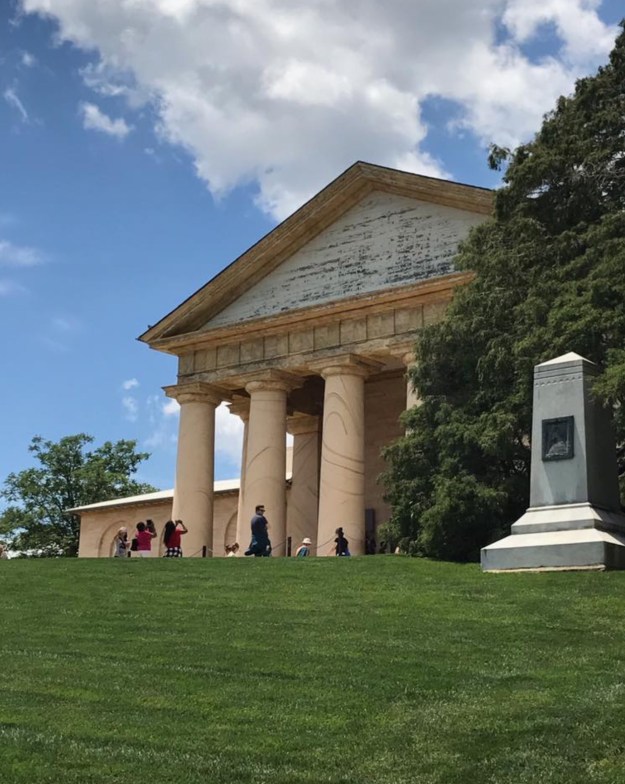
(Photo Credit: The Historical Traveler)
For my latest travels, I visited Arlington National Cemetery in Arlington, Virginia. Arlington National Cemetery is a military cemetery that is on the opposite side of the Potomac River in our Nation’s capital, Washington D.C. Arlington National Cemetery is a site of many amazing military history exhibits including The Women in Military Service for America Memorial. It is also the home of the historic Tomb of the Unknown Soldier and the burial place of two US Presidents: William Howard Taft and John F. Kennedy. I spent the majority of my visit at what is known as “Arlington House” or the “Custis-Lee” mansion which was once the home of General Robert E. Lee and family. It was a very interesting visit to the house and I learned first-hand the rich history of the house starting from the construction of the house many years ago.

(In front of Arlington House, Photo Credit: The Historical Traveler)
The property was originally owned by Martha Washington’s grandson, George Washington Parke Custis, and was built in 1802 and completed around 1818. When George Washington Parke Custis passed away in 1857, he left the estate to his only child, Mary Anna Custis Lee, who was married to Robert E. Lee.
In 1862 during the Civil War, the government took possession of the home due to the owners not being able to pay the property taxes in person. General Lee was away at war and Mrs. Lee had fled the property due to impending danger. She tried to have a relative pay the taxes for her in person but it was not allowed and so therefore, the federal government took possession. To most likely punish the Lee’s, who were thought of traitors for siding with the Confederacy, the grounds surrounding the home were converted by 1864 into a cemetery for the war dead with the first burial being in Mrs. Lee’s beloved rose garden – all done in spite to ensure the Lee’s never returned to the property.
In1882, twelve years after Robert E. Lee’s death, the family sued the U.S. government for illegally confiscating their land. United States v. Lee concluded with the Supreme Court ruling in favor of the Lee family. Since the years had passed and so many were now buried on the property, the family decided to sell the property to the US government.
In 1925, the US Congress passed a law to make Arlington House a memorial to Robert E. Lee. In the 1930’s, the National Park Service obtained the house where it has remained a staple for every history buffs enjoyment
The house maintains original furniture, which is predominantly showcased in my two favorite rooms of the house: the White Parlor and the Family Parlor. The White Parlor (which is located on the left upon entering the house) has Robert E. Lee’s famous red furniture and a bookcase that belonged to our first President himself, George Washington!
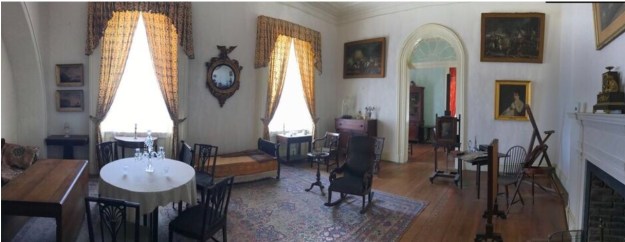
(The White Parlor, Photo Credit: The Historical Traveler)

(George Washington’s Bookcase, Photo Credit: The Historical Traveler)
The Family Parlor is directly across the hall of the White Parlor, and was used as a recreational room for the Lee children. There’s an easel with painting supplies which are original pieces including a self-portrait done by one of the Lee children. The desk on the far left is a piece I learned was recently donated by one of Lee’s descendants, as well as many other pieces in the house.
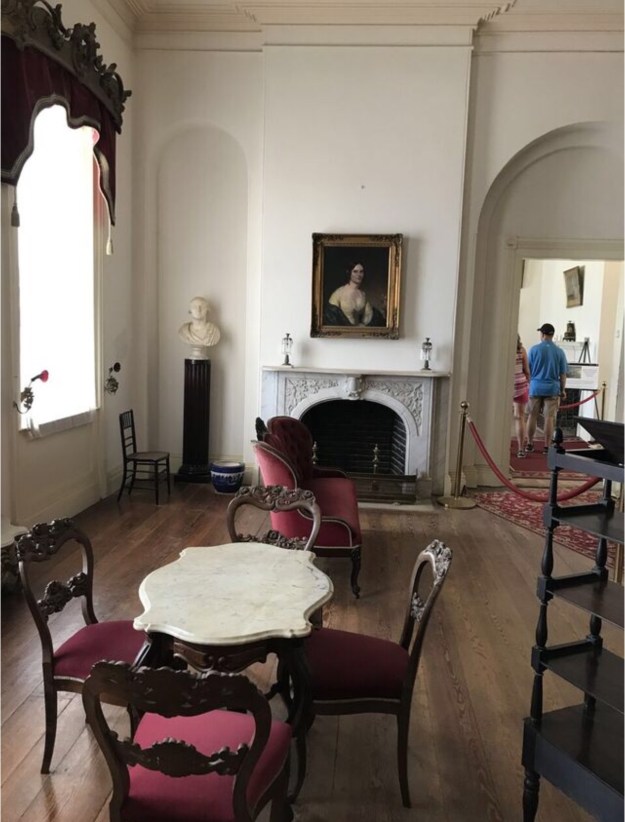
(The Family Parlor, Photo Credit: The Historical Traveler)

(The easel, Photo Credit: The Historical Traveler)
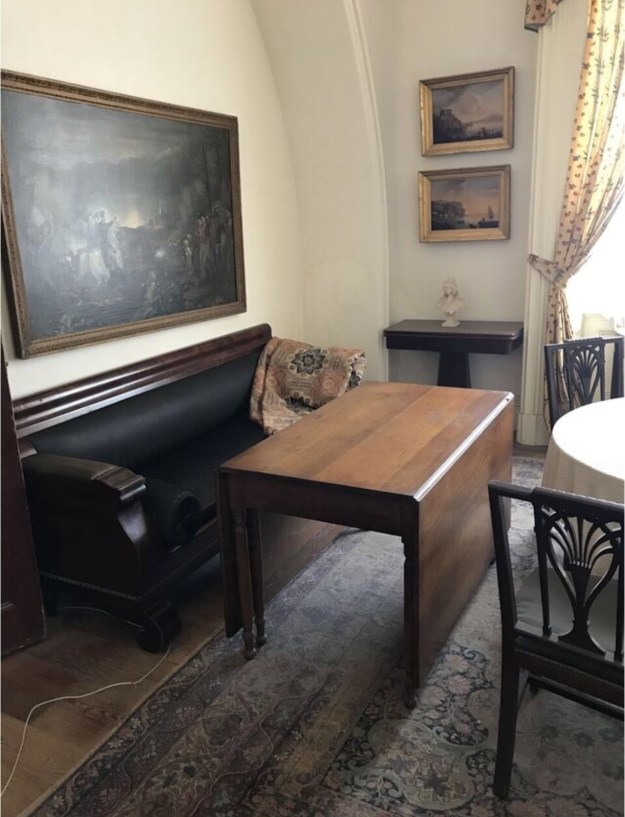
(The desk, Photo Credit: The Historical Traveler)
This coming August, Arlington House will be temporarily closed for two years due to upcoming updates to the museum including how visitors experience the house.
Fun fact: The updates are all being paid for by David Rubenstein, a philanthropist who demonstrated his passion for American history by paying for the Washington Monument to be restored following the 2011 earthquake.
You should definitely visit Arlington House before they’re closed for two years and make sure to go on one of the tours offered at the top of every hour. To plan your visit to Arlington House at Arlington National Cemetery, click here: http://www.nps.gov/arho/index.htm

(The view from the house, Photo Credit: The Historical Traveler)
In the Kitchen Tonight…Spoonbread
Spoonbread is so simple to make and I love simple recipes that are not complex. As I always like to point out: I am not a Martha Stewart type (no offense to the “Martha’s” out there!) Here is a wonderful recipe from Mount Vernon and its so neat to think that maybe Martha Washington used this same simple recipe to make this special treat for George. The history of Spoonbread goes all the way back to the Native Americans and it was a favorite of President James Monroe’s. The first recipe in print was published in 1847 in a fabulous cookbook authored by Sarah Rutledge titled: The Carolina Housewife.
Here is what we came up with in the kitchen tonight. It was simple. Fun. Yummy!
 The Historical Homemaker