Author Archives: The Historical Homemaker

The Historical Traveler: Ford’s Theatre and The Peterson House

For my second historical visit, I traveled to Ford’s Theatre and The Peterson House in Washington, DC: the sites of President Abraham Lincoln’s assassination and death.

Since the assassination, Ford’s Theatre has been converted into a museum where you can learn everything about the assassination including the many attempts on his life before the fateful night in April 1865. You learn about the foreshadowing of the assassination from both President Lincoln and the man who shot him.  You also learn of the lives and about the trials of those who conspired to (and were then charged with and then put to death) kill President Lincoln.
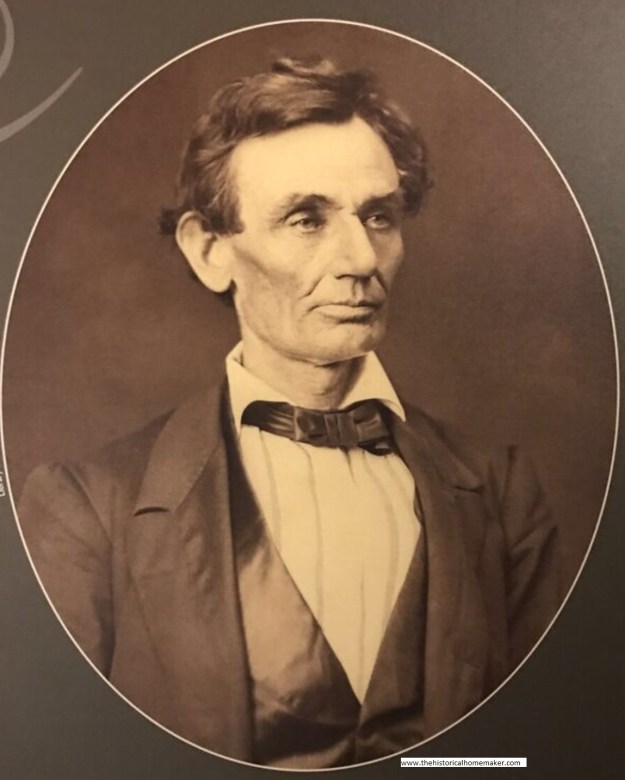
fords-theater2                                 A young picture of Abraham Lincoln on display at Ford’s Theater

In 1860, Abraham Lincoln became the 16th President of the United States with 40% of the votes in a four-way contest.

During a speech the following year Abraham Lincoln concluded his speech with these words:

“…if this country cannot be saved without giving up that principle (freedom)…I would rather be assassinated on the spot than to surrender it…”

There were many attempts on President Lincoln’s life including one from a group who named themselves the “Plug Uglies.” After this attempt, President Lincoln was advised to stay armed and carry a weapon on his persons.  He refused to do this and stated, “would not for the world have it said that Mr. Lincoln had to enter the National Capitol armed.”

fords-theater

These are the actual weapons given to President Lincoln that he refused to have on him

John T. Ford opened Ford’s Theatre in 1863 under the name Ford’s New Theatre after it having been converted from a First Baptist Church.  Ford’s New Theater became a popular escape for entertainment during the depressing years of the Civil War.  Many popular actors of the day performed at Ford’s Theatre including John Wilkes Booth.  John Wilkes Booth was very famous and was known for his athleticism and his southern pride. He came from a famous Theater family and his father was the popular actor Junius Booth.

fords-theater3 John Wilkes Booth father: Junius Booth.  On display at Ford’s Theater.

Interesting Fact: During a performance of The Marble Heart, John Wilkes Booth directed his threatening lines towards the Presidential Box at Ford’s Theatre while President Lincoln was in attendance. He knew President Lincoln was watching and Booth hinted publicly his dislike of President Lincoln.

john_wilkes_booth-portrait

John Wilkes Booth in 1865

The conspiracy to assassinate President Lincoln started in the boarding house of Mrs. Mary Surratt where she and other conspirators plotted the assassination. Of the conspirators who were put on trial following the assassination, four were sentenced to death: including Mrs. Surratt. She unfortunately is known as the first woman to be executed by the US government.

Ford’s Theatre has the stories of each individual conspirator on display as well as statues representing their likeness.  I found that I am personally a lot taller than the conspirators but am of course, much shorter than President Lincoln – who was 6’3″

fords-theater5

Here I am standing next to one of the conspirators!

The theatre itself is very spacious and open.  The stage is not too high off the ground and the circular design of the room works really well.

Pictures of the theatre including seats, ceiling and stage

Although visitors are allowed to walk around the theatre, the Presidential Box where President Lincoln was assassinated is closed off.

fords-theater10

Picture of the Presidential Box at Ford’s Theatre

You can go through the door frame where John Wilkes Booth entered and waited to assassinate President Lincoln was really neat to see.

fords-theater7

Picture of the outside of the Presidential Box at Ford’s Theatre

Across the street from Ford’s Theatre is The Peterson House, which is where President Lincoln was carried to upon being assassinated and where he took his last breath.

peterson house.jpg

Me standing in front of The Peterson House

The Peterson House remained a boarding house for immigrant families after the death of President Lincoln. After the owner passed away, The Peterson House was stripped of all the interior decorations and converted into a newspaper headquarters.  After being purchased by the government, The Peterson House was converted into a museum along with Ford’s Theatre.  Unfortunately, the decorations and furnishings inside the home are mostly not original pieces.
fords-theater11

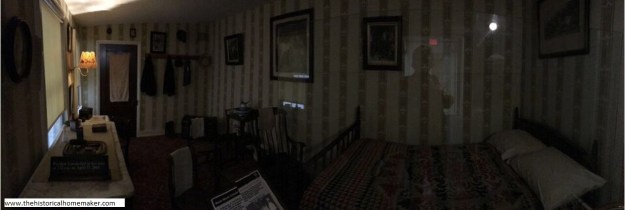
Picture of the room where President Lincoln passed away. The bed was on the far right.

The room where President Lincoln passed away is furnished almost identically to how it was when he was carried over from Ford’s Theatre.  They have recreated the room with a photograph taken the evening of the assassination.

The Peterson House is an extension of the museum which chronicles the manhunt for John Wilkes Booth and the impact of President Lincoln on the world.

fords-theater13

Picture of the John Wilkes Booth manhunt trail

You can follow the trail he took from Washington, DC into Virginia where he was finally caught and shot – which he then succumbed to his wounds.

Through The Peterson House is a spiral staircase with a statue of Abraham Lincoln books in the center and every flight of stairs down is another part of Lincoln’s legacy.  One floor showcased the despair felt across the Nation by telling the details of the many funerals held for President Lincoln across the United States. Funerals were held in Washington, DC, Boston, Baltimore, Harrisburg and Philadelphia – just to name a few cities.

Interesting Fact: The turnout for these funerals were astounding averaging 100,000 people per funeral, and reaching over 1 million in New York.

President Lincoln was finally laid to rest in his hometown of Springfield, Illinois.

Following the same stairs downward was a room where people who passed by can leave notes describing their ideas on what qualities Abraham Lincoln possessed including courage, ideals for equality and integrity.

The staircase ends where the bottom of the statue begins and concluded my self guided tour of Ford’s Theatre and The Peterson House. There is so much more information and so many lessons to learn from going through these museums.  Tickets are easy to purchase although you will probably want to plan your trip in advance online here because the theatre is still used for productions to this day.

Ford’s Theatre is a 100% MUST SEE visit! I promise you will have a great time and learn so much along the way.
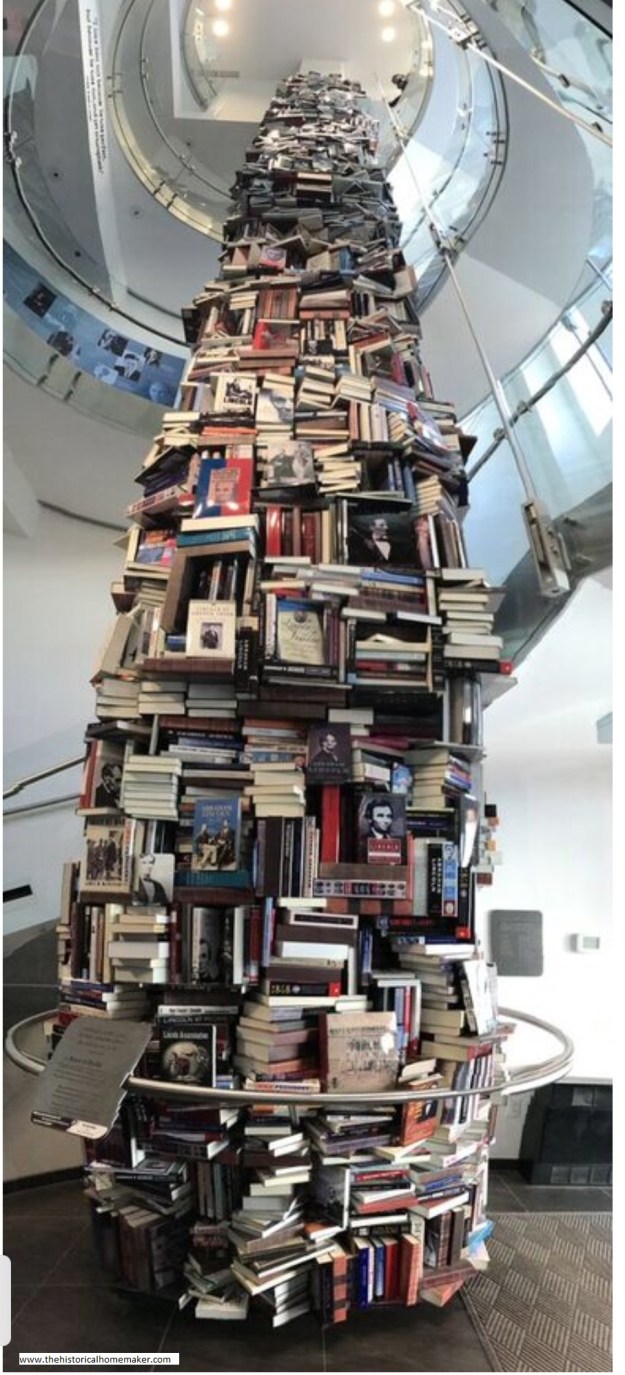
fords-theater14 Picture of the statue of books

The Historical Traveler Visits Mount Vernon


img_5850Yesterday was a perfect day to visit Mount Vernon – the first President’s home. The father of our country.
Everybody knows our first President of the United States of America, George Washington, is famous for many things including being a decorated General and leader during the American Revolution.

While visiting his beloved home, Mount Vernon, I learned more of the “other side” of George Washington, including his early contributions in expert farming and fishing on the Potomac River, as well as his amazing craftsmanship and original architecture. All of which took place on the property of his estate.

It was fascinating to learn that Mount Vernon once housed meetings before and during the
Revolutionary War.

This beloved home of George Washington has since been turned into a museum where millions gather each year to learn about our first President.

George Washington believed that the path to economic growth and success as a Nation lied within the ability to naturally produce agricultural products. Washington studied farming extensively including implementing the new husbandry system which included a variety of fertilization methods and a new crop rotation system.

img_5868

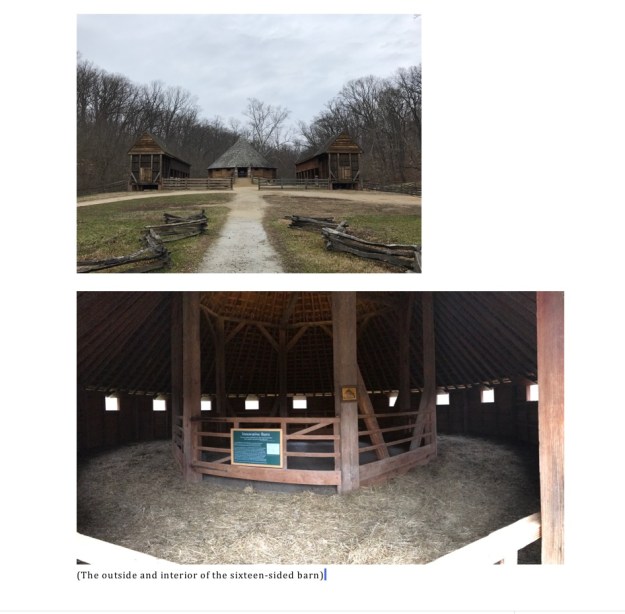
George Washington even built a custom barn, inventing a new way to collect grain. He constructed this innovative barn with sixteen sides for circular treading. Horses and mules would trot around in the grain, which would collect below the barn and stay sheltered from harsh weather conditions until it was time
to collect it.

Mount Vernon sits on the Potomac River, which was used for fishing and was part of what then was considered a highway or interstate of the time. George Washington took advantage of this fishing, believing the other path to growth as a Nation was expanding West. In a good season of fishing, Washington would catch more than one million Shad Herring to feed his family, guests, and slaves. Washington would then sell the surplus for profit, running his own fishing business in his own backyard.


img_5869
(Interesting Fact: While I was on the Potomac River dock on the property I learned that on March 28th, 1785, representatives from Virginia and Maryland met at Mount Vernon to discuss navigational rights on the Potomac River. The representatives wrote the Mount Vernon Compact and the meeting was such a success that it led to many more meetings of the same nature, and in turn led to the US Constitution which was written in 1787 and put into effect in 1789.)

George Washington died in 1799. He had written in his will that he wanted a new tomb to be laid to rest in instead of what is now called the Old Vault which is also on Mount Vernon.

After visiting the tomb, I then made my way to George Washington’s famous home, which I can tell you is even more beautiful on the inside as it is on the outside. Unfortunately no pictures were permitted inside the house so you’ll have to take my word for it until you visit yourself someday.

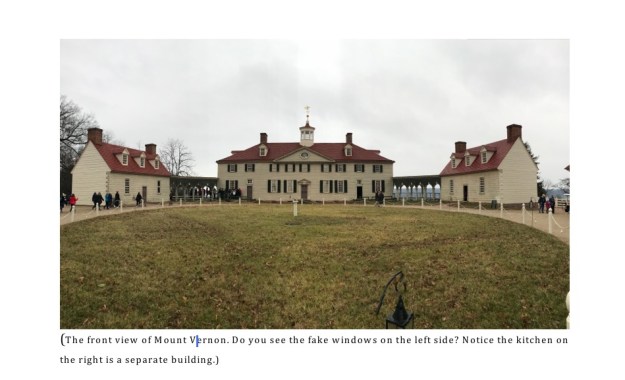
The outside of the house is the same color as it was when George Washington was living in it, and if you look closely you can see three false windows on the front facing left side of the house. They are boarded on the inside because Washington was fond of art but wanted to keep the home looking symmetrical from the
exterior. The home included a servants hall on the very left, an art gallery, nine bedrooms including the master bedroom and the many guestrooms, and a kitchen on the outside of the house in a separate structure.

img_5874
On the other side of this wall with the fake windows is a room dubbed ” The New
Room” because it is the last addition to Mount Vernon that George Washington added.

The New Room served as an art gallery with original paintings still on display all over the
room. There were maybe two-dozen portraits, most of which were of rivers.

The curators of the home think this is because he was very adamant about expanding West and using the water for business and transportation.

Upstairs and through one of four guestrooms is the master bedroom where George and Martha once slept.

This room particularly was interesting because it has more original pieces than any other room in the house, including a desk where Martha
would sit and do work, and a large linen closet for storing the many towels required when housing several guests; something the Washington’s frequently did.

The master bedroom also still has the bed George Washington died in. President
Washington died of an infection in bed surrounded by his loved ones December 14, 1799.

(Interesting Fact: During George Washington’s last year, Mount Vernon housed over 600 guests!)

Downstairs from the master bedroom is George Washington’s study, which is my favorite room on the tour. In his study, Washington obtained 900 volumes and 1,200 titles containing information on anything and everything he could read and learn about. Washington valued education on a personal and public scale believing knowledge is very important. On display in his study is Washington’s original desk with an invention of his chair designed to fan his shoulders and back during the warmer summers via pedal under the desk.

Also in his study, Washington has a portrait of his half-brother, Lawrence Washington. Lawrence mentored Washington when he was young before the Revolutionary war.

(Interesting fact: George Washington inherited Mt. Vernon from his older half-brother, Lawrence, after Lawrence inherited the estate from their father.)

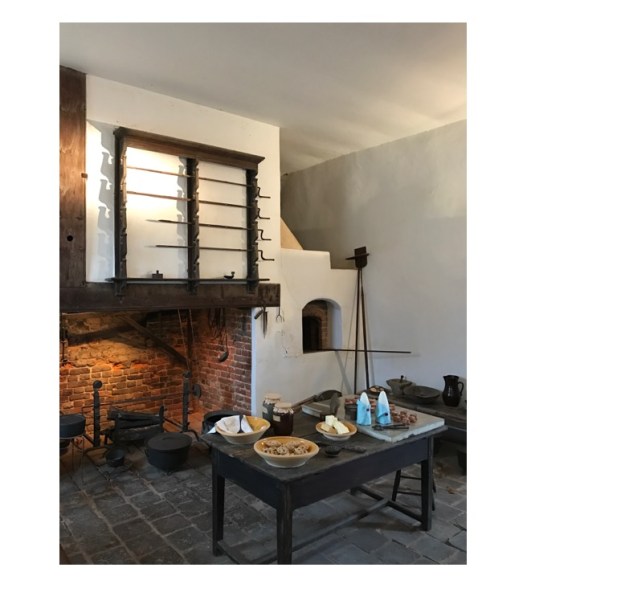
Through the next rooms and the other side of the house in a separate structure was the kitchen. Thankfully pictures were allowed here because it’s not part of the home.

The idea in moving the kitchen outside away from the house was to keep extreme
heat and hazards away from the main building. The kitchen includes stairs in the back that lead up to where the kitchen slaves lived. The downstairs was used for cooking and cleaning and early methods of food storage.

img_5875


After leaving the tour of the home, I made my way to the museum because I read online there was a new exhibit called Lives Bound Together. Pictures were again not allowed inside the exhibit so I couldn’t take any inside. Lives Bound Together displayed the many stories of slaves who resided and worked on Mount Vernon and the way President Washington was influenced by their lives. Throughout the exhibit were virtual life stories of slaves who labored varying from different parts of Mount Vernon including kitchen staff, farm hands, and George Washington’s personal butler. I think the exhibit is definitely worth going through when you visit Mount Vernon and I think everyone should see it – the exhibit speaks for itself.

img_5876

(Interesting Fact: George Washington was having ethical dilemmas regarding slavery later in life. Washington prioritized national unity over abolition believing that abolition would divide the country. He went on to free 123 slaves in his will immediately following his death.)

My day at Mount Vernon was an experience I am very happy I had. George Washington is the original American hero and visiting his home along with learning about what an amazing man he was makes me personally proud to be a citizen of the country he helped establish roots for.

I’ve barely scratched the surface with how much there is to learn and experience here at Mount Vernon. New exhibits are still on the way so plan your visit to Mount Vernon by visiting http://www.mountvernon.org where you can see learn about new exhibits and special events! They even have a military discount!

~ Trevor 


Mary Todd Lincoln House – Lexington, Ky

Some years ago, my hubby and I had the chance to visit The Mary Todd Lincoln House in Lexington, Kentucky. What a treat it was to walk the same floors that Mrs Lincoln walked many years ago. To touch the same stair bannister that Mr Lincoln touched and walk into the same bedroom that he stayed in on his only visit to the house.

The home has many original family artifacts from the Todd family and also Mrs Lincoln’s personal items from her later years in life.

Mary Lincoln spent many happy girlhood years in this home with her family when she lived here from 1832 to 1839 – when she moved to Springfield, Illinois. She would then soon after meet the love of her life and as the saying goes…the rest is history.

a98d92ca-f1b1-46f6-b696-5438c8ebdf51

In the Kitchen Tonight…Onion Soup

I believe winter has officially arrived in Virginia! Tonight was the perfect night to make something wonderful to keep us warm – so why not make a pot of yummy soup 🙂 Tonight we stepped back in time and made something that was most likely enjoyed by the Washington family – how cool is that?

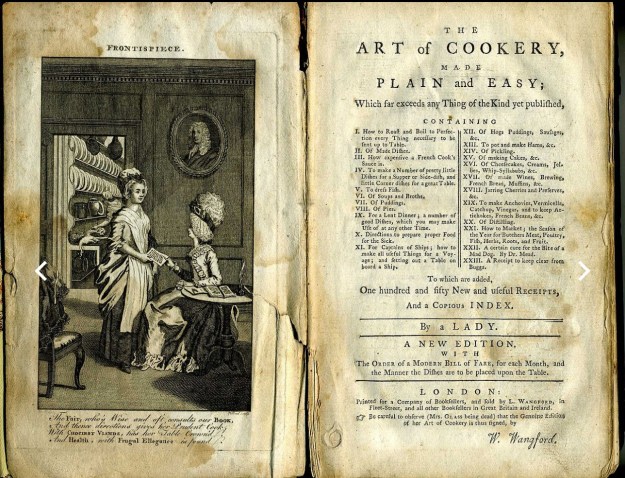
While researching recipes today I was looking for something that was not complex and had only a few ingredients. So – this recipe for Onion Soup was perfect and I found it on the Mount Vernon website.  It most likely was made in the Washington household and was a recipe included in the Hannah Glasse cookbook, The Art of Cookery Made Plain and Simple,which was first published in 1747 and went on to become a best seller for a century after it was published.

fullsizerender-2

The recipe was very easy and I truly recommend you try it at home. If you have onions (a lot!), flour and broth? You are all set…here is the actual recipe:

Onion Soup

Ingredients:

1/2 cup (1 stick) unsalted butter
2 1/2 pounds onions, peeled and coarsely chopped (7 to 8 cups)
1/3 cup all-purpose flour
4 cups water
2 cups Basic Beef Stock
1 teaspoon salt
1 slice bread, toasted and diced
2 large egg yolks, lightly beaten
1 tablespoon balsamic vinegar
Ground black pepper

Directions:

  1. Melt the butter in a heavy skillet over medium heat. When the butter is sizzling, add the onions, cover, and cook for about 15 minutes, stirring often to prevent them from sticking to the pan, until they are very soft and caramelized. Add the flour, stirring to coat the onions, and cook for about 1 minute.
  2. While onions are cooking, combine the water and stock, and bring to a boil over medium-high heat. When the onions are ready, mix them into the hot stock, stirring until well combined.
  3. Pour a little of the hot stock into the skillet and stir, scraping up any onion particles that remain. Pour the stock into the stock and onions, and add the salt.
  4. Stir in the diced toast, cover, and simmer for about 10 minutes.
  5. Combine the egg yolks and vinegar. Gradually blend 1/2 to 1 cup of the hot soup into the egg yolk-and-vinegar mixture, stirring constantly to prevent the yolks from curdling. Stir the mixture into the soup, and simmer for several minutes until the soup thickens just slightly, stirring constantly. Again, do not let the soup boil, or the egg yolks will curdle.
  6. Season with pepper and additional salt, if necessary, and serve hot.

~~~~~~~~~~~~~~~~~~~~~~~

Of course we have our fun pictures from the kitchen tonight. Thank you to my ever so patient husband for cutting the soooooo many onions and for being my official taste tester.

img_5592

We started with the basic…

img_5596

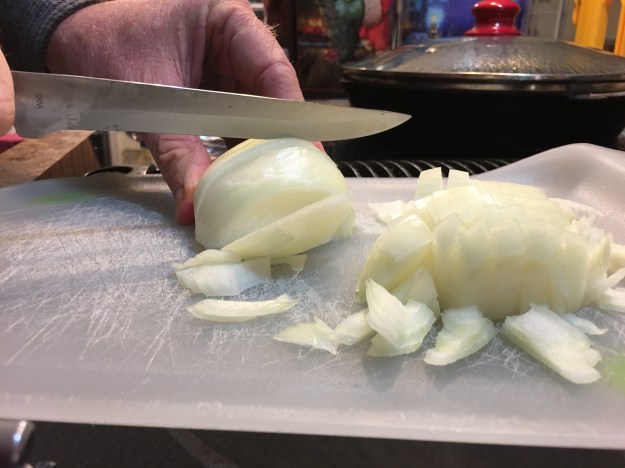
My hubby chopped and chopped (and chopped!) 

img_5597

Fabulous onions 

img_5598

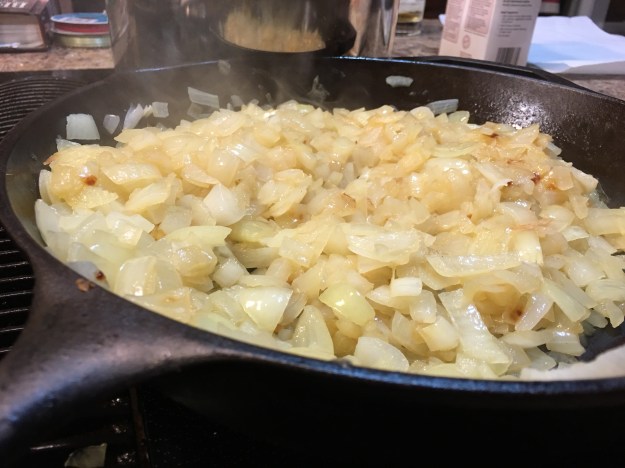
My ever so faithful cast iron skillet was wonderful tonight – here we are getting ready to saute the onions 

img_5601

caramelized onions – after about 15 minutes.  Then added flour for minute. 

img_5600

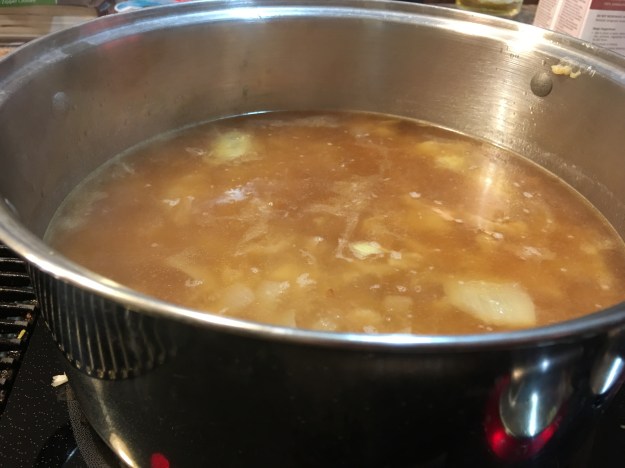
In a separate large pot – added the broth and water 

img_5602

The water, broth and onion combination 

img_5603

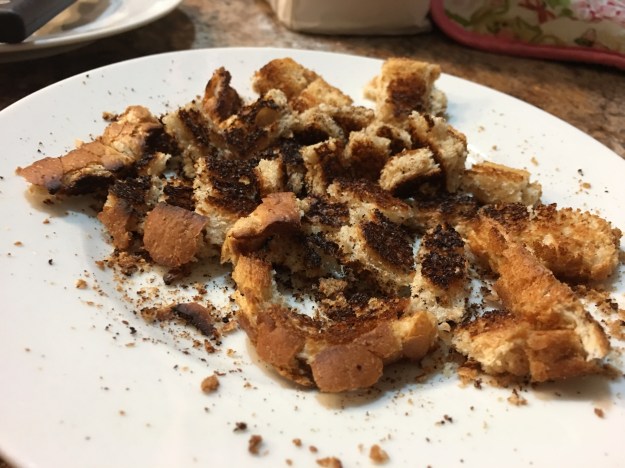
Chopped toast is added to the soup…

img_5604

along with egg yolks and vinegar 

img_5605

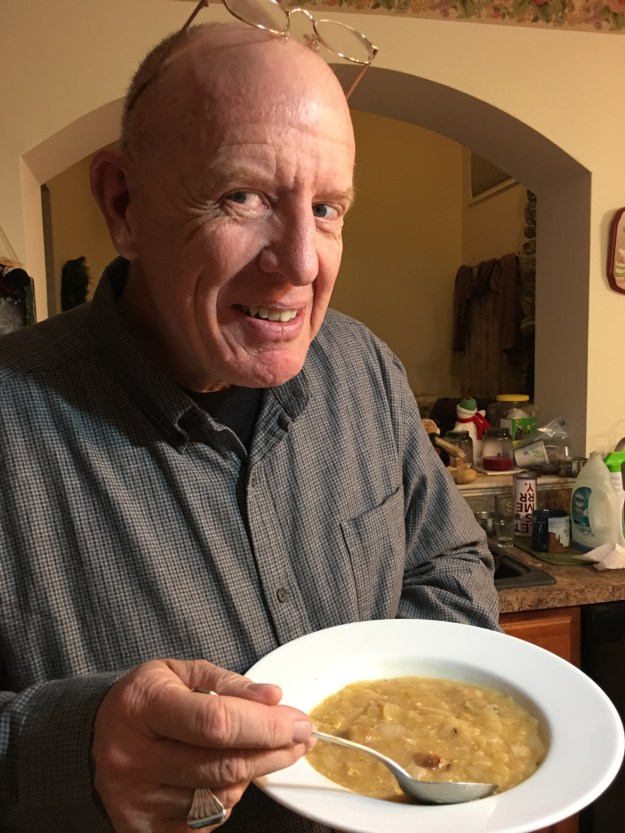
We have soup! 

img_5608

and my hubby loved it! Success! 

In the Kitchen Tonight…Gingerbread

While researching on what to make in the kitchen today – I came across a delightful (and easy!) recipe for Gingerbread that was used during the Civil War era. If they could, families of the Union soldiers would often send small care packages of gingerbread, socks, soaps and other food items from home.  Since Gingerbread required molasses, it was a popular staple to make being that molasses was much cheaper to purchase than sugar in the Civil War era. This is why Molasses Cookies were also a popular item back in this era.

Here is the recipe that was used today:

Gingerbread

Ingredients

1 tablespoon of butter (used for greasing the pan)

2 1/2 cups of flour

1 1/2 teaspoons of baking soda

1/2 cup of butter

1 1/4 cups of molasses*

1 egg

1 1/2 teaspoon of cinnamon

1 1/2 teaspoon of allspice

1 cup of very hot water

Directions:

Preheat the oven to 350 degrees. Grease a 9″ square baking pan with the butter (1 tablespoon).  In a large mixing bowl, combine the flour, soda and spices, and cut in softened butter to the four mixture with a fork.  Combine molasses, egg and water in a small mixing  bowl.  Add the liquid ingredients to the dry ingredients and stir well.  Pour the batter into a baking pan and bake 35-40 minutes or until a toothpick inserted into the center comes out clean.  Makes 9 servings. (Source: http://www.totalgettysburg.com)

*It seemed as if everyone in town was making something with molasses this weekend and after going to 3 stores…I relented and looked online for a molasses replacement (who knew that molasses was so popular in my small town??!!) Here is what I used as a replacement for molasses in this recipe:

1 1/4 cup dark corn syrup (you can also use honey or maple syrup)

1 cup firmly packed brown sugar

1 cup granulated sugar

1/2 cup water


In the Kitchen Tonight…Mary Todd Lincoln’s White Cake

We wanted to do something special tonight in the kitchen to honor and remember the wedding anniversary of Abraham and Mary Lincoln who were unitedin marriage on November 4, 1842.  

I have read ALOT of books about the lives of both Abraham and Mary Lincoln and what has always seem to peak my interest about these two is how they both came from such diverse backgrounds – she grew up with servants and living in a beautiful home in Lexington, Kentucky while he was born in a log cabin in the backwoods of Kentucky.  Somehow they simply found one another and with the trials and tribulations of courtship (their previous engagement was broken off and her family was not thrilled about her marrying someone “beneath” her) they decided that in the end, they simply wanted to be together.  

Mary Lincoln made a white cake for Abraham Lincoln while they were courting and it was one of his favorites after they were married. So, with yesterday being their wedding anniversary, I felt it was very fitting to make something that was dear to both of their hearts (and their taste buds!)

The recipe that I used was from the book, Lincoln’s Table, by Donna D. McCreary and was adapted by Janice Cooke Newman. 

Mary Todd Lincoln’s White Cake 

Ingredients:

  • 1 Cup blanched almonds, chopped in a food processor until they resemble a coarse flour

  • 1 Cup butter

  • 2 Cups sugar

  • 3 Cups flour

  • 3 teaspoons baking powder

  • 1 Cup milk

  • 6 egg whites

  • 1 teaspoon vanilla extract

  • confectionary sugar

Directions:

  • Preheat oven to 350 degrees. Grease and flour a bundt cake pan.

  • Cream butter and sugar.  Sift flour and baking powder 3 times. Add to creamed butter and sugar, alternating with milk.  Stir in almonds and beat well.

  • Beat egg whites until stiff and fold into the batter.  Stir in vanilla extract.

  • Pour into prepared pan and and bake for 1 hour, or until a toothpick inserted comes out clean.  Turn out on a wire rack and cool.  When cool, sift confectionary sugar over top.

  • A basic white frosting sprinkled with almonds was also popular.

In the Kitchen Today…Molasses Cookies

We spent a wonderful time in the kitchen today with family and friends as we experimented with using an authentic Civil War recipe to make a batch of Molasses cookies. Did you know that one of the most popular foods of the soldiers were Molasses cookies? Sugar was very, very expensive during the war years as well as sugar was slowly processed.  Molasses was an alternative choice due to it being less processed (and less expensive).

Molasses Cookies

“A cup of brown sugar, one of molasses, one of lard, half a cupful of boiling water, one spoonful of ginger, one of saleratus (baking soda with impurities), one of salt and flour enough to roll. Beat the sugar, lard, molasses, saleratus and ginger together; then pour on the boiling water and mix in the flour. Roll about three-fourths of an inch thick and cut with round cutter. Bake in a quick oven (375 to 400 degrees)”

Our notes from today: The recipe called for a “spoonful” of a few ingredients and we had to decide whether to use a teaspoon or tablespoon (teaspoon won!) and because we did not have lard on hand, we used margarine in it’s place and seemed to work just fine.  We also used Self Rising Flour so that we didn’t need to add in the baking soda and salt. Also, the recipe said to “mix in the flour” and it was a fun time trying to figure out how many cups of flour to use (we used a little over 8 cups).  In the end, the cookies came out fabulous and we were very excited to have made an authentic recipe used in the Civil War era.

We used the recipe from Regimental Cooking

img_5159-1img_5161-1img_5163img_5168-1

Welcome to The Historical Homemaker

I have had this vision for a long time now on how I could potentially express my love and appreciation for American history. Since childhood, I have been fascinated by the stories of our founding fathers and of course, our founding mothers.  Their stories fascinated me, visiting the homes where they once ate and slept were so intriguing.  I will never forget how excited I was as a child to see the bedroom that George Washington slept (and died) in at Mount Vernon or be in the same room at Arlington House where Robert E. Lee wrote his resignation letter to the U.S. Army because he did not want to take up arms against his homeland in Virginia.

Throughout the years, I have been incredibly blessed to share my joy of American history with my two sons – we spent many days visiting civil war battlefields (most recently Gettysburg!) historic homes and monuments. In 1999, my oldest son and I had the chance to be at Mount Vernon for the reenactment of George Washington’s funeral.  For us to share this historic experience together was amazing. As their mother, I have always felt it was very important to share these stories of our past with them so that they, in turn, will pass these stories down to their own children someday and these stories will continue to be shared with the generations to come.

I am incredibly excited to share my journey with you – of all things and all aspects of American history.

Sincerely,

Coleen, The Historical Homemaker